

I'm the first guy to call something out as too good to be true. So when I saw a heat pump spec sheet claiming it was over 400% efficient, my reaction wasn't "wow."... it was "who's lying to me."
Nothing is 400% efficient. You can't get more out than you put in. That's not marketing, that's basics. I went and dug into it myself, tired of people looking at me like I have three heads when I repeat these numbers.
Here's what I found early on at GreenStart - The numbers are real. And once you see the trick, it stops sounding like a scam and starts sounding obvious.
Why 100% is the ceiling for a furnace, and not for a heat pump
Start with a normal gas furnace or an electric space heater. Both of them make heat. The furnace burns fuel, the heater runs current through a coil, and the energy gets converted into warmth. The best you can ever do with that approach is turn 100% of your energy into heat, and in the real world you lose some up the flue or in the wires, so you land under 100%. That is the ceiling for anything that creates heat.
A heat pump doesn't create heat. It moves heat. Heat that already exists. That one word, 'move' instead of 'make', is the whole game.
The trick: it's a pump, not a furnace
There is already heat in the air outside your house, even on a cool day. A heat pump uses electricity to grab that existing heat and pump it indoors, the same way a water pump uses a little energy to move a lot of water uphill. The electricity isn't becoming the heat. It's just doing the moving.
So the math works like this. Put in one unit of electricity, and a good heat pump can deliver several units of heat into your home, because most of that heat wasn't created, it was relocated. The Department of Energy puts it plainly: a properly installed air-source heat pump can deliver up to two to four times more heat energy than the electrical energy it consumes, because it transfers heat instead of burning a fuel to make it. Ground-source (geothermal) systems can reach even higher, which is where the top of that "200 to 500%" range comes from.
The industry has a proper name for this ratio. It's called COP, the Coefficient of Performance: heat delivered divided by electricity used. A COP of 4 means four units of heat for every one unit of electricity. Multiply by 100 for the "400% efficient" number that made me suspicious in the first place. It was never breaking physics. It was just measuring something differently from what I'd assumed.
"Pumps heat from the cold" is not a typo
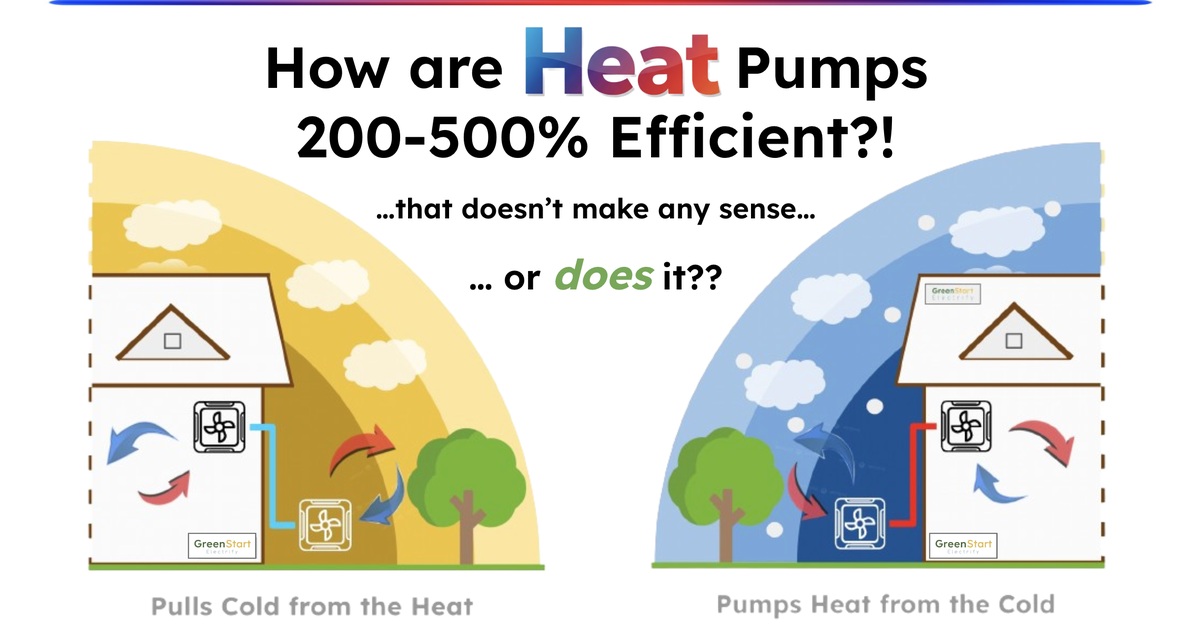
Look at the graphic at the top of this post and you'll see two lines that sound like nonsense: pulls cold from the heat, and pumps heat from the cold. Both are true, and they're the same machine running in two directions.
In summer, the pump pulls heat out of your house and dumps it outside. That's just air conditioning, which is a heat pump you already understand. In winter, it reverses: it pulls heat out of the outdoor air, even when that air feels cold to you, and moves it inside. Cold air still holds usable heat. There's a lot of energy in air that's at 40 degrees, and the pump's job is to concentrate it and bring it in. Same box, flipped valve, heat flows the other way.
What you'll actually see on the spec sheet
COP is the clean way to explain the concept, but it's not the label stamped on the equipment you'd buy. Since 2023, the Department of Energy rates these systems with two numbers you'll see on the sheet: HSPF2 (for heating-season efficiency) and SEER2 (for cooling-season efficiency). Higher is better on both, the same way higher miles-per-gallon is better on a car. If a contractor is quoting you a heat pump, those are the two figures worth comparing, and they connect directly back to the COP idea: they're just seasonal, real-world versions of "how much comfort per unit of electricity."
But what about when it actually gets cold?
Fair question, and it's the honest limit of the story. The colder it gets outside, the less heat there is to grab, so the pump has to work harder and the COP drops. There's even a hard physical ceiling on how good any heat pump can get, set by the temperature gap it's pumping across (the Carnot limit, if you want the term). No machine beats it, which is the real reason the number isn't infinite.
The good news is that modern cold-climate units have gotten very good at the low end. In the Department of Energy's Cold Climate Heat Pump Challenge, validated systems kept delivering heat at temperatures as low as -15 degrees Fahrenheit. If they work in Minnesota, the question of whether they work here mostly answers itself.
Why this hits different in Southern California
Here's the part that matters for your bill. That COP drop only bites when it's truly cold out. In our climate, from Santa Barbara down through Ventura and into the rest of SCE territory, it rarely gets cold enough to push a heat pump into its weak range. That means your system spends most of the year running up in the high-efficiency part of its curve, delivering multiples of heat per unit of electricity almost al the time. The efficiency story that sounds too good to be true is actually at its strongest right here.
Two more things make it better. Run that pump on power from your own solar and you're heating and cooling your home on your own electrons instead of buying them. And on the cost side, local programs can knock down the price of the switch: 3C-REN and 3CE rebates cover heat-pump HVAC and heat-pump water heaters, which we break down in our other blog posts.
So no, it's not a scam, and you can stop looking at me like I have three heads. A heat pump is just a very good mover of heat, and in this climate it barely ever has an off day.
If you want to actually know what's best for your home, with your roof, your energy usage and bill, start with your data and we'll map your plan together. Lower costs, lower CO2.