
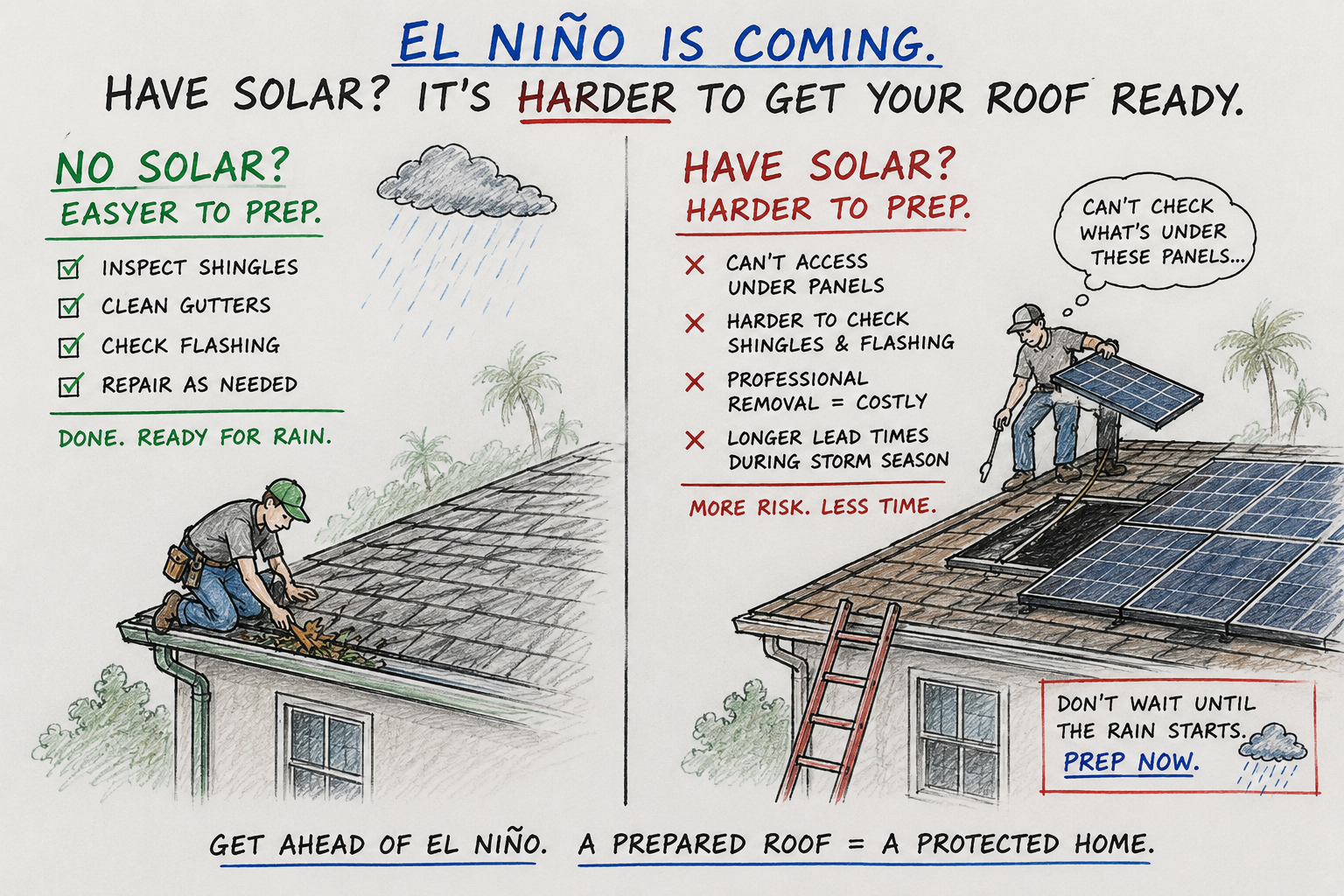
Forecasters are calling for a strong El Niño this winter, and for Southern California that's worth thinking about now rather than after the first storm blows through. Below is what it actually means for your house, what the science does and doesn't promise, and the piece of maintenance that costs a lot less handled before the rain than during it.
Will El Niño actually bring rain?
Probably. Not for certain, but the odds lean hard toward a wet, stormy winter.
El Niño is a warming of the tropical Pacific that nudges the jet stream south and tends to send more storms across the southern U.S., us included. This year it's already here, and it's a big one. NOAA's Climate Prediction Center put out an El Niño Advisory back in July, and its forecasters give it an 81% chance of reaching "very strong" by December and a 97% chance of hanging on through early spring. When it sets up like that, the southern half of the country usually ends up wetter than normal.
The history is what makes people sit up. The last two really strong El Niño winters, 1982-83 and 1997-98, soaked California. San Diego pulled close to 20 inches in each of those years against a normal of about 10. The 1997-98 season went down as one of the wettest on record statewide and did hundreds of millions of dollars in flood and storm damage. Even the more recent wet winters have been enough to set off mudslides and close roads, including the slide that shut down Topanga Canyon.
Now the fair caveat: a strong El Niño tips the odds, it doesn't sign a contract, and a few of them have fizzled out. But when Southern California does catch a big one, it comes down hard. The houses that come through in good shape are almost always the ones that got ready in the fall.
What a wet winter does to a house out here
Most homes in SoCal are built and kept up for dry weather. We go months without real rain, so roofs and drains almost never get tested. Then a genuine winter shows up and goes looking for every weak spot at the same time.
A cracked tile, a tired piece of flashing, a little gap around a vent: in July, none of that is a problem. Put it under a January atmospheric river and that same small flaw turns into a live leak. Once water gets into the roof deck or the attic, you're looking at rot, mold, and a repair many times bigger than the one you skipped. Saturated hillsides start to move. And the storms that bring the rain usually bring wind and power outages with them.
Get your roof looked at before the first storm
This is really the whole point, and it isn't complicated. The cheapest, least stressful time to deal with a roof is a dry afternoon in October. The most expensive time is in the middle of a storm, water already inside, when every roofer in the county is booked solid and racing the next system in.
So get ahead of it. A roof near the end of its life, or one that hasn't had eyes on it in years, is exactly what a winter like this finds. We'll come take a look, tell you straight what it actually needs, and get any repairs or a full replacement done before the weather turns. Our roofing is in-house, and we're licensed for both general building and roofing (CSLB #1126181), with a 20-year workmanship warranty behind the work. If your roof is already living on borrowed time, this is the year to handle it instead of gambling on it.
A couple of things while you're up there
Two more worth mentioning.
Storm season is also outage season. More and more of the house runs on electricity now, from the heat to the hot water to the stove, so a multi-day outage stings more than it used to. A home battery keeps the essentials on when the grid drops, and there's no better time to have one than the middle of a winter storm.
And if the roof does need work, that's the natural moment to think about what goes on top of it. Doing a re-roof and solar together, on one timeline, is how you avoid paying to pull panels off and put them back on a few years later. (More on that in our post on [roofing and solar timing].)
A quick pre-storm checklist
A few things any homeowner can knock out before the rain sets in:
- Get the roof inspected, especially if it's over 15 years old or has never been checked.
- Clear the gutters and downspouts, and make sure water drains away from the house.
- Look inside for old leak signs: ceiling stains, bubbling paint, a musty smell up in the attic.
- Cut back any branches hanging over the roof.
- If you count on power for medical equipment or working from home, make an outage plan and think about backup.
Don't wait for the leak
Maybe this winter breaks records and maybe it doesn't. Either way the prep is the same, and it's cheap next to what a bad leak costs. The homes that sail through a wet SoCal winter belong to the people who made the call back in the fall.
If you'd like yours checked before the first big storm, reach out and we'll come take a look. Start with the roof, and we can talk through the rest of the house from there.